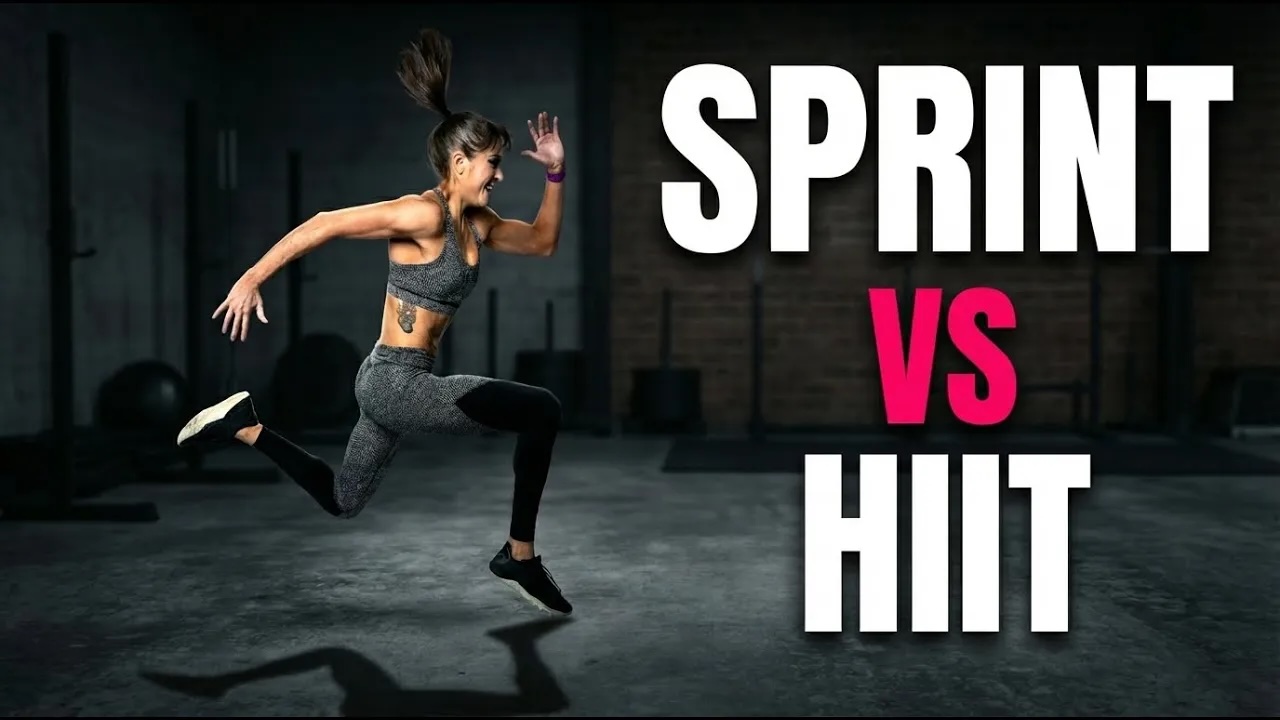
Over the years, the terms HIIT and Tabata have become wildly popular.
Some people use them interchangeably to describe any hard interval workout.
But technically, they’re not the same thing.
Tabata, in its true form, is actually what we’d call Sprint Interval Training, or SIT.
These are short, all-out bursts.
True sprints that can also include explosive power work.
HIIT, on the other hand, is a broader category, which I’ll dive into a bit shortly to clarify the differences and opportunities in each type of training.
Both can be amazing tools, but they target different systems and produce different outcomes.
This muddying of the definitions is often why people don’t see the results they want.
Not all interval work benefits you the same way.
The movements you choose and the work-to-rest ratios you use completely change the effect and how each session complements your strength training or recovery days.
When I’m designing efficient routines to focus on building strength and muscle, but while staying leaner, I focus on SIT and Power protocols.
These are shorter, more explosive intervals than traditional HIIT.
They’re incredibly effective for improving body composition, speed, power, and recovery, and they keep your metabolism healthy and responsive.
However, if you want to focus primarily on fat loss over focusing more on building muscle, HIIT can and should be used too.
The key is not demonizing any form of training but instead tweaking your systems to work toward YOUR goals.
And while steady-state cardio, such as long distance running or riding has its place, it can become catabolic, breaking down muscle tissue if used excessively.
If you’re going to include steady-state work, especially if you love your endurance sport, you just need to be conscious of the downsides when working to improve your metabolic health and body composition.
Now let’s talk about SIT and Power work – what they are, and why you need them.
Sprint Interval Training and Power protocols are short bursts of high-intensity effort where you go all-out.
And I mean ALL OUT.
Every interval of work should be that true 100% intensity.
Now, if you’re thinking, “I can’t run or jump. My knees won’t handle that,” you’re not off the hook!
Sprinting doesn’t have to mean pounding the pavement running or a ton of high impact work.
“Sprinting” simply means working at max effort for a short burst.
And this can be done on any cardio equipment or with any exercise that allows you to go hard safely.
That could mean using a bike, a rower, a ski erg, sled pushes, kettlebell swings, or medicine ball throws for example.
You’re training intensity, not impact.
If you can sustain your effort for more than 30 seconds, it’s not a true sprint.
And you’re not doing these intervals for an hour.
The goal is quality, not quantity.
Think quick, powerful, intentional effort even if it’s just a 5 minute session.
These sessions are short because they’re so intense, usually 5 to 8 rounds, never really more than 10.
You can start with just one session a week and still see massive benefits.
Now, I also want to clarify how SIT and Power work differ from HIIT, because these terms get thrown around a lot.
And honestly, there is still some debate around definitions.
HIIT stands for High Intensity Interval Training.
It’s a broader category that can include different types of timed circuits and longer intervals of work.
While you can run, ride, swim or row, even circuits using more compound moves like push-ups, squats, or burpees for time can work.
You will be working hard, but not necessarily at full capacity.
Think more 80% intensity to have just enough energy to keep moving and finish the rounds as fast as possible, or get as many rounds done in the time assigned as you can.
SIT and Power training use more specific intervals designed for maximal output.
And that means you can’t skip the rest.
With HIIT, your intensity can dip. That’s okay to work more at 80% max effort.
But with Power work, it shouldn’t. You want every round explosive.
If you do feel your 100% is no longer a true 100%, you’ll be training slowness, not speed.
With SIT work, you’ll go all-out for 8 to 30 seconds, then recover long enough to truly repeat that level of intensity.
Different interval designs and intensities help you reach different goals.
HIIT improves work capacity and general conditioning.
SIT and Power work improve performance, metabolic flexibility, and muscle preservation.
Think of it this way: HIIT builds endurance in your engine. SIT and Power work build the size and horsepower of that engine.
All are valuable – they just serve different purposes.
Let me outline some more specifics to use them…
Power work uses shorter work intervals of 8 to 12 seconds with longer rests of about 40 to 60 seconds.
You should finish each rest period itching to go again.
If you’re still tired or slowing down, you’re not training explosiveness, you’re training fatigue.
So don’t keep doing more! You’re wasting effort!
This style of training builds speed, coordination, and neuromuscular efficiency (that mind-body connection).
This directly improves your strength work too, because better neural drive means you can lift more, move better, and recover faster.
Sprint Interval Training, or SIT, pushes you closer to your limits and can create some central nervous system fatigue.
Work intervals are anywhere from 8 to 30 seconds with shorter rest periods, maybe half the work time up to two or three times the length of the interval.
The longer the work interval, the more you want to consider longer rest to maintain max effort.
Although unlike Power work, you may not fully recover between sprints.
The goal is to maintain near-maximal effort even under fatigue.
That’s what creates incredible metabolic and conditioning benefits.
SIT helps improve insulin sensitivity, builds lean muscle, decreases visceral fat, and even boosts both anaerobic and aerobic capacity.
Studies show that combining SIT or Power work with strength training accelerates fat loss, especially that stubborn belly fat, while improving muscle gains and performance.
And here’s what’s amazing: these protocols are especially powerful as you age.
That’s right!
Many people avoid intensity as they get older because they think it’s “too hard” or “too high impact.”
But it is exactly what we need.
Intensity doesn’t have to mean impact.
And training intensely is what keeps our body functioning optimally especially with hormonal changes that happen with age.
Use it or lose it!
SIT and Power work help maintain lean muscle, balance hormones, and improve reaction times – all things that decline with age.
And specifically for women going through perimenopause or menopause, this kind of training helps regulate insulin, preserves muscle, and fights that stubborn belly fat.
So stop blaming age or using it as an excuse not to Sprint or do HIIT.
These protocols help your body stay responsive, strong, and metabolically active.
If you’re wondering what a sprint or power interval may look like, check the video description.
Just remember, these aren’t meant to be hour long sessions.
Keep the total work time short, no more than 5 to 10 minutes total is needed, and make every interval count.
You can include SIT after a strength session for stubborn fat areas, or do power intervals before lifting to prime your nervous system for better performance.
Start with one session a week.
Once you’re comfortable, build to two or three.
These sessions should complement your muscle-building work not compete with it.
Now, let’s talk about the other form of cardio your metabolism and body, heck even your BRAIN, will thank you for at the other end of the cardio spectrum…
Walking.
Walking is the ultimate recovery tool.
It works in the fat-burning zone, lowers stress hormones, and supports hormonal balance overall.
And the great part is, even if you’re starting back?
It’s accessible to everyone no matter your age or fitness level.
You don’t need fancy equipment or long sessions.
Even starting with 10 to 15 minutes a day can make a big difference.
Walking helps regulate your blood sugar levels, improves your body’s ability to burn fat for fuel, and speeds up recovery after more intense workouts.
It also helps manage cortisol levels so you can build muscle and lose fat more efficiently, especially key during menopause when we can see cortisol and inflammation levels rise.
Aim for 7,000 to 10,000 steps a day if you can.
But don’t get hung up on the number.
Just move more.
Morning walks, post-meal walks, or steady outdoor walks on rest days are all fantastic options.
Here’s the thing: you can’t just add more and more high-intensity work forever.
So if you’re thinking about adding more SIT or HIIT instead of a walk to move more?
Don’t.
Exercise is a good stressor…But it’s still stress!
There IS a point of diminishing returns.
More intensity isn’t always better – it’s about balance.
SIT and Power work give you intensity.
Walking gives you recovery.
Together, they build a stronger, healthier metabolism…One that helps you stay lean, energized, and free from burnout.
So if you want to improve your body composition, performance, and long-term health…Don’t skip the sprints and don’t underestimate the walks.
Train hard, recover smart, and design with purpose.
Because the strongest, healthiest version of you doesn’t come from doing more.
It comes from doing what matters, intentionally and consistently.
VIDEO DESCRIPTION PROTOCOLS:
12/60 Power Session
Complete 8 to 10 rounds through the sprints.
12 seconds sprint
60 seconds rest
20/10 SIT Session
Complete 8 to 10 rounds through the sprints.
20 second sprint
10 seconds rest
For more workouts to build your leanest, strongest body, check out Dynamic Strength:
–> LEARN MORE



0 Comments