Pull Up:
Have you had Pull Ups as one of your goals for awhile? Feel like you'll just never get there no matter how much you work on them? Feel like all you ever do is get better at the assisted variations?
Well maybe it's because you're not doing the right assisted variations or using them in the right way!
If you just keep trying to do MORE REPS with assistance, instead of fewer reps with constantly harder and harder variations, you'll simply become better at the assisted variation.
Plus, depending on the type of assistance you use, it may be causing you to not learn how to properly engage at different points in the pull ups.
While Band Pull Ups are a popular way to modify the pull up, they are not my favorite.
Why?
Because bands give the most assistance at the bottom and often start us at a point where we never have to learn how to engage our back properly at the bottom.
Ever feel like if you just started a little above a dead hang you could easily do a full pull up?
That's because you haven't been working to learn that initial engagement from a dead hang. You aren't able to engage your back and go from just hanging to retracting and depressing your shoulder blades. And if you've been using bands, it's because the band puts you in a position where you're above that initial engagement point.
So because the band hinders you from learning that initial engagement, they aren't my favorite way to modify. (Of course now knowing that, you can use them if that isn't your problem OR even keep using them but also include Mini Pull Ups. Just always know why you are using certain moves and their upsides and downsides!)
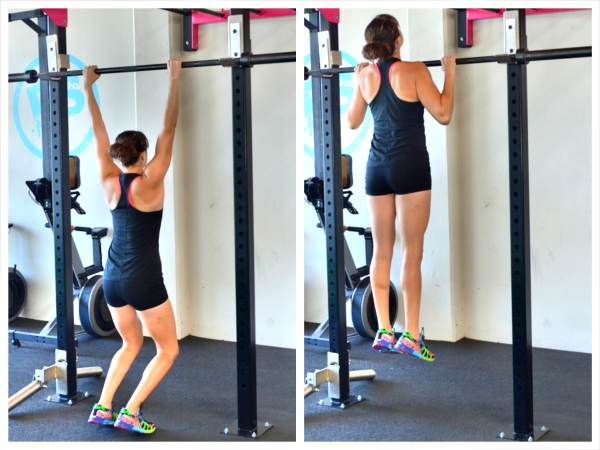
Instead of doing Band Pull Ups, I like to use Foot-Assisted variations or even Jumping Pull Ups...and with both you can even use a controlled Eccentric to build even more strength!
The Foot-Assisted Pull Ups are a great way to control exactly how much assistance you give yourself and even adjust as you fatigue. Plus, you can provide consistent tension throughout the entire move.

To do Foot-Assisted Pull Ups, hang from the bar or trainer and place your feet flat on the ground in front of you or your toes right behind you. Either foot position works, just make sure you set up so you can pull straight up without arching your back or letting your hips come up and forward. You don’t want a huge arch in your body or to turn this into a row. You want a vertical pull.
As you hang at the bottom, you'll want to move from a dead hang with your shoulder up by your ears to retracting your shoulder blades down and back as you press your chest up toward the bar. Leading with your chest, pull yourself up.
Use your feet only as much as needed to pull up. Your goal is to use your back and arms as much as possible. Pull your chin all the way above your hands and try to get your chest to your hands.
Then lower back down, fully extending your arms at the bottom, returning to the full dead hang. Feel your back working as you lead with your chest to pull up and lower down. You don't want your upper traps or arms to be the only thing you feel.
To make the move harder, use your feet less or even just one one foot. You can also change up the tempo of this movement and do a very controlled slow lower down. By slowing down the eccentric portion aka the lower down, you will spend more time under tension, which can help you build more strength more quickly.
If you're ready or maybe don't have a bar at a height you can use your toes, you can also modify the pull up by doing a Jumping Pull Up with slow eccentric.
To do the Jumping Pull Up, set up under a bar that is high enough off the ground that you can hang from it, but low enough that you can use your legs to help get your chin up over the bar.
Hang from the bar with your feet flat on the ground. You can do this with either a chin up or pull up grip. Then jump, and at the same time, pull yourself up with your arms to get your chin up over the bar. Only use your legs as much as is needed to get your chin over the bar. Think about leading with your chest as you jump up.
At the top pause if possible and then slowly lower yourself back down, fully extending your arms at the bottom before you jump up again.
Try not to pause at the bottom or let go of the bar but quickly repeat the move, slowing down the lower down to take on your own bodyweight as long as possible. By slowing down the lower down, you'll spend more time under tension AND take on your own bodyweight even though you're not yet able to do a full pull up.
With both of these modified variations, it is best to do fewer reps with a more advanced variation. If you're looking for that first full pull up, you don't need to be doing 10 reps, but instead 1-3 reps with the hardest variation you can do!
Ok so say these are all well and good but you want to modify the pull up because you don't have a bar to do them from and they are included in your program?
Two great exercises I will sometimes sub to modify the Pull Up are the Band Lat Pull Down and the Inverted Row.
Both of these can help you build back strength and work on your scapular mobility to improve your pull ups as well as your posture.
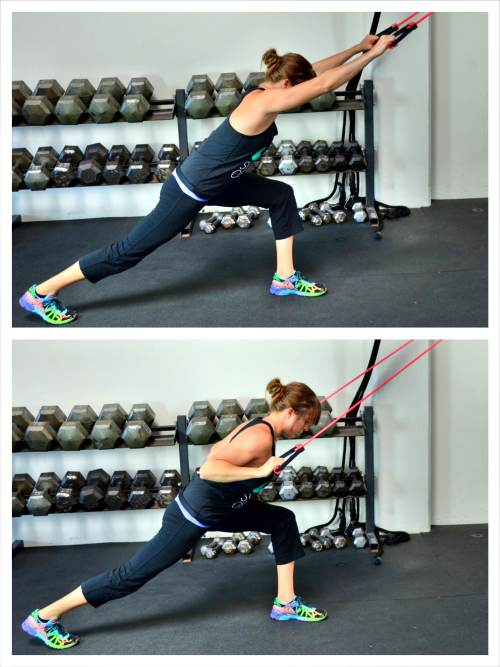
To do the Band Lat Pull Down, anchor the band up high and, holding a handle in each hand. Walk back away from the anchor point and set up in a lunge stance.
Lunge back while facing the anchor point and lean your chest over your front knee. Your back leg can be straight, but you want to make sure to lean forward so that you work your lats and are performing a movement that mimics a vertical pull.
Reach your hands up overhead. There should be tension in the band with your arms extended. If there isn’t, move back. Then pull the band down toward your shoulders, driving your elbows down and back. The movement should mimic you pulling yourself up to a bar for a pull up.
As you pull down, pinch your shoulder blades down and together. Focus on working your back muscles. You want to feel the sides of your back pulling the band down. Don’t just go through the motions. You want to consciously activate the big muscles of your back.
The slowly extend your arms back out and repeat. Each time you pull down, drive your elbows down and back.
Keep your core engaged the entire time and your back flat. Do not start to straighten up and turn this into a row instead of a pulldown.
You may also feel this move in your legs because you are holding a low lunge. You can do pulldowns with a few different grips. You can have your palms facing the ground (pull up grip), palms facing you (chin up grip) or palms facing each other (neutral grip).
Change the tempo or move back further from the anchor point to make the move more challenging. Just like with the pull ups, you can slow down the eccentric portion.
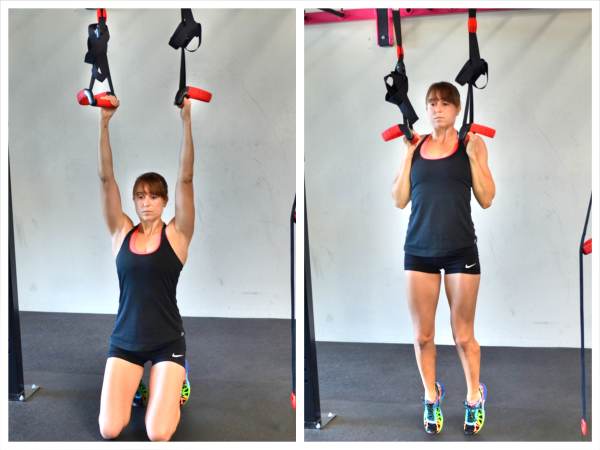
And while the Inverted Row is a horizontal pull, unlike the Band Lat Pull Down that mimics the vertical pull, it is a great move to supplement your pull up work and even modify the pull up to start.
To do the Basic Inverted Row, you can either use a Suspension Trainer or a Bar. Using a Suspension Trainer, hold a handle in each hand with your palms facing in. Walk your feet forward so that your body is at an incline. The closer to parallel to the ground you get, the harder the move will be.
Hang from the straps with your body in a nice straight line and your chest pressed out. Engage your core and glutes and keep your legs straight. You want a nice straight line from your head to your heels. Do not let your low back arch or your hips sag toward the ground.
Then drive your elbows down and back to row your chest up to the handles. Keep your body in a nice straight line as you row up and do not bounce off the bottom. Keep your wrists straight as you row up. Also, do not shrug your shoulders.
Then lower back down. Do not lose tension at the bottom. Make sure to keep the chest pressed out and your body in a nice straight line. Do not swing to row back up.
Make sure to feel your back and arms working to row and not just your arms. Focus on feeling your back pull.
As you build up your pull ups, you can even have some fun playing around with these 28 Pull Up Variations.
And for 3 keys to help you improve your pull ups, check out this Pull Up post as well!













Band hip hinge ,what’s so I purchase this?I hav3 right sided hip pain
I’m not sure what you’re asking. Sorry Nicky!
Thank you so much for this Cori. Very well written helpful article. It is appreciated.
Glad it helps Mark!
This article – with all it’s links – was/IS SOOOOOOOO helpful! Thank you Cori!
Glad it helped Joan!
Thank you very much Cori, not only will your knowledge inspire me and humbled me for sharing this information that is gold, but i want to learn English to understand better
use translator jajaja
Fantastic and very detailed articles! So grateful to have found redefining strength and Cori! Been working with the Macro Hacks and diet. My wrists have become very weak in the last few years away from working out. Any specific suggestions for strengthening them?
So glad it helps Lynn! Sometimes our wrists feel weak but there are actually mobility restrictions causing overload. I think this article may interest you – https://redefiningstrength.com/wrist-pain-with-push-ups-these-tips-and-exercises-will-help/